Importance of Lab Support with Dr. Chafitz
Together with The Dental Lab, Dr. Evan Chafitz recently hosted CE Zoom event, “The importance of laboratory support for the restorative dentist” to discuss how the lab is very similar to the surgical specialist and how to integrate digital dentistry for support in the dental lab and vice versa–with digital dentistry being the crux of the lecture.
This article will cover the key components of the event, discuss Dr. Chafitz’s background and practice, aspects of digital dentistry, and go over implant case studies.
Who is Evan Chafitz?
Dr. Evan Chafitz is a Doctor of Medicine in Dentistry and a board-certified Oral and Maxillary surgeon (OMFS). However, he no longer practices maxillary facials anymore. Moreover, Dr. Chafitz is the Chairman of the Board of Advisors of the College of Dental Medicine, an Associate Professor at the New York Medical College, and a consultant with Straumann, Nobel, 3shape, and Zahn.
He has been practicing for 27 years and his office is based in Scarsdale, New York, and is almost exclusively focused on implant surgery and related procedures with particular attention to digital applications–Implant surgery, digital planning, bone grafting, etc. Over half of the implants placed in his office are immediate implants. Dr. Chefitz also lectures nationally on these topics and consults on the digital aspects of implant dentistry.
His practice is fully digital with a full-time laboratory technician, a five-access mill, multiple 3D (three-dimensional) printers, and intraoral and laboratory scanners. His successful business was built by being available, having the knowledge and education, providing support and trust, creating relationships with his labs and patients, and being digital.
In discussing knowledge and education, Dr. Chafitz believes that “You can’t do well if you don’t know what everyone else is doing.” He believes in being aware of current trends and continuing to learn new methods and techniques and encourages others in the dental industry to follow suit.
Furthermore, Dr. Chafitz’s practice is 100% referral based; they do not participate in direct patient marketing. He says, ultimately, his business comes down to relationships. As a restorative dentist, he learned that they basically get patients from their referring patients – particularly implant patients. He stated that patients almost exclusively show up from a dentist who refers and sends them over for evaluation. In turn, he and his office work in support based on feedback and quality of the work, the patient experience, timeliness, etc. How happy the patients determine if his practice gets more work or doesn’t.
Lastly, Dr. Chafitz praises digital dentistry, stating, “Digital allows for easy communication between surgeon and labs and provides support,” allowing him to work hand in hand with his referrals and The Dental Lab from planning to restoration. He highlights the digital communication aspect by noting that “It’s nice to [be able to] call the lab prior to doing the case for suggestions and planning.”
For further questions or concerns, Dr. Evan Chafitz can be reached at chafitz@scarsdaleoralsurgery.com.
Terms and Concepts Used in Digital Dentistry
Workflow is the sequence of industrial, administrative, or other processes through which a piece of work passes from initiation to completion. It is composed of where you’re starting to where you’re ending; it’s just a matter of how we do things in order.
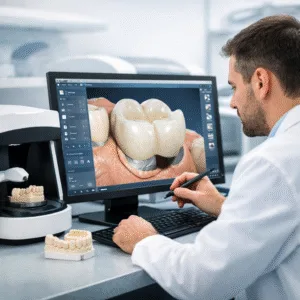
Computer-assisted design (CAD) is a computer technology that designs a product and documents the design’s process. CAD may facilitate the manufacturing process by transferring detailed diagrams of a product’s materials, processes, tolerances, and dimensions with specific conventions for the product in question. It is essentially computer software with all the parameters set in it. Examples include Exocad and 3shape.
Computer-aided manufacturing (CAM) is an application technology that uses computer software and machinery to facilitate and automate manufacturing processes. CAM can be subtractive when used in milling for final crowns or dentures, or it can be additive through 3D printing.
Standard of care–in legal terms–is the level at which an ordinary, prudent professional having the same training and experience in good standing in the same or similar community would practice under the same or similar circumstances.
Scan bodies are specific for the restorative component and brand. There are a variety of scan bodies available and each has its own advantages and disadvantages. It is important to use the scan that your lab is comfortable with.
Immediate placement is placing the implant fixture at the time of tooth extraction.
Immediate provisionalization is placing a provisional restoration at the time of implant placement. Wait time can be up to a day or two–sometimes three when it’s indicated.
Indications in The Dental Lab
- The intact facial bone wall between the buccal plate and implant should be greater than 1 millimeter (mm) to avoid grafting membrane;
- Biotype refers to the thickness of the keratinized tissue or the gingiva; thicker is better;
- A flapless procedure is preferred;
- Corona-apically should be placed apical to mid-facial crest. Implants should not be mid-root, but 1 mm or so below the crest when looking at it directly from the buccal;
- When looking from the occlusal gap, between the implant and facial bone wall should be at least 2mm. If you can’t do this, bail. Cancel if you feel you don’t have the right criteria met;
- Consider early placement with soft tissue healing if additional soft tissue volume is needed or a thin biotype.
Considerations in the Dental Lab
- Presence of infection;
- Biotype of gingiva; be wary of very thin biotype;
- Presence of buccal plate;
- Anatomic structures; need stability;
- Significant amount of grafting;
- Ability to achieve primary stability;
- Insertion torque;
- Implant stability quotient (ISQ) values; generally comfortable loading if ISQ is over 70;
- Implant size;
- Smoking;
- Associated risk factors, such as diabetes.
Options for Temperization
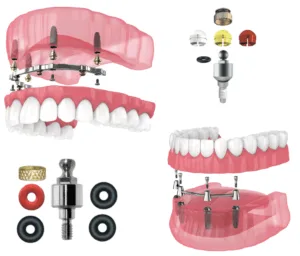
Options for temporization include flippers, bonded bridges, or immediate load temporaries that can be milled or completed chairside.
Chairside vs. Lab Fabricated Dental Restorations
Chairside or traditional is usually performed during an emergency. It is time-consuming and results in implants that are not highly polished and may have voids and gaps. Proper contour varies.
As these cases are generally emergencies, the Doctor of Dental Surgery (DDS) has to work to fit them into the schedule. On average, these cases take about 45 minutes to complete. They may not produce the optimal result if in a rush.
Dental labs should always be involved in fabricating provisionals simply because it is easier and better. Labs are specialized to fabricate teeth, which ultimately leads to better results: no gaps, highly polished, sits correctly against the gingiva.
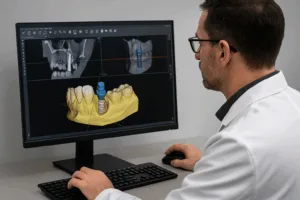
Labs also provide the opportunity to use digital. “Digital is a series of tools that allow us to gather data, treatment plan, and perform dentistry with more accurate diagnosis and better execution.” However, a digital workflow is not a substitution for clinical skills, experience, and knowledge of the implant process. Ultimately, understanding the concepts, limitations, and techniques involved enables better, cleaner, and more efficient accomplishments. Proper data collection, planning, and collaboration are key to the best outcomes.
Case Study
Furthermore, Dr. Chafitz presented a case study he mentored as well as a timeline for the following procedure. The Dental Lab is completing the final restoration for this case.
While Dr. Chafitz served as the mentor for the presenting case, the practicing clinician was General Dentist, Dr. Cole Conboy of Steubenville, Ohio. The initial laboratory technician was CDT Nitasha Rizvi of Scarsdale, New York.
In the presenting case, two teeth are totally out of the arch form, there is gingival recession, decay, bone loss, and no posterior teeth. The patient has failing upper and lower dentition and desired a fixed restoration, but prefers not to wear a removable at any point.
Plan:
- Cole prepares three upper and four lower teeth for temporary crowns.
- Evan and Nitasha take the scans and digitally extract all the remaining teeth.
- CT-guided templates are made for six implants per arch by Scarsdale.
- Upper and Lower provisionals are made for the prepared teeth to support full-arch provisionals in the occlusion.
- Cole will extract non-prepared teeth and place 12 implants, graft, and insert the provisionals on the day of surgery.
Timeline:
- October 20, 2022 – Cole contacts Evan to discuss the new case.
- October 21, 2022 – STL, Dicom files, and clinical pictures were sent to Evan for review and workup.
- October 23, 2022 – Evan and Cole review and formalize a plan via a Zoom call.
- October 26, 2022 – Cole does the initial preparations and sends new STL files.
- October 31, 2022 – Evan and Nitasha reviewed and finalized the plan with Cole for the implant surgical guides and provisional restorations.
- November 4, 2022 – The procedure is performed by Cole.
Key Takeaways:
- With proper planning and techniques, seemingly difficult cases can be handled methodically and accomplished confidently.
- Collaboration with the lab as early as possible gives the greatest chance of accomplishing what is wanted.
- Knowledge of what can be done is sometimes as important as knowing how to do it.
Summary
The main impressions that Dr. Chafitz had to share were:
- Healing, gingival response, and bone response will be improved with a smoother surface–no matter what is engaging the implant.
- Immediate placement and temporization work when the proper selection criterion and proper techniques are used.
- The less the tissue is manipulated, the better the healing response of both the soft tissue and the bone supporting the implant.
- Dental CAD/CAM temporaries that are lab-finished offer the best clinical outcomes when compared to traditional methods.
Dental Lab Near Me
We are an end-to-end Dental Laboratory local to Bristol, Pennsylvania but operating across the nation. Family-owned and operated, our lab delivers restorative dental products and services at affordable prices. We are also highly digitized; We utilize advanced technology and techniques available to make us a great choice for digital dentistry solutions and restorations. Contact us for further questions or concerns.
Keywords:
The Dental Lab, Dental Lab, dental lab near me, Dental laboratory, dental CAD CAM, dental surgical guide, implant surgical guide, surgical guide, surgical guide for dental implant, surgical guide implant